

A regional HVAC provider replaced manual, geography-blind scheduling with a booking engine that only offers time slots its fleet can physically reach — turning route efficiency into a constraint enforced at the moment of booking, not patched up afterward.
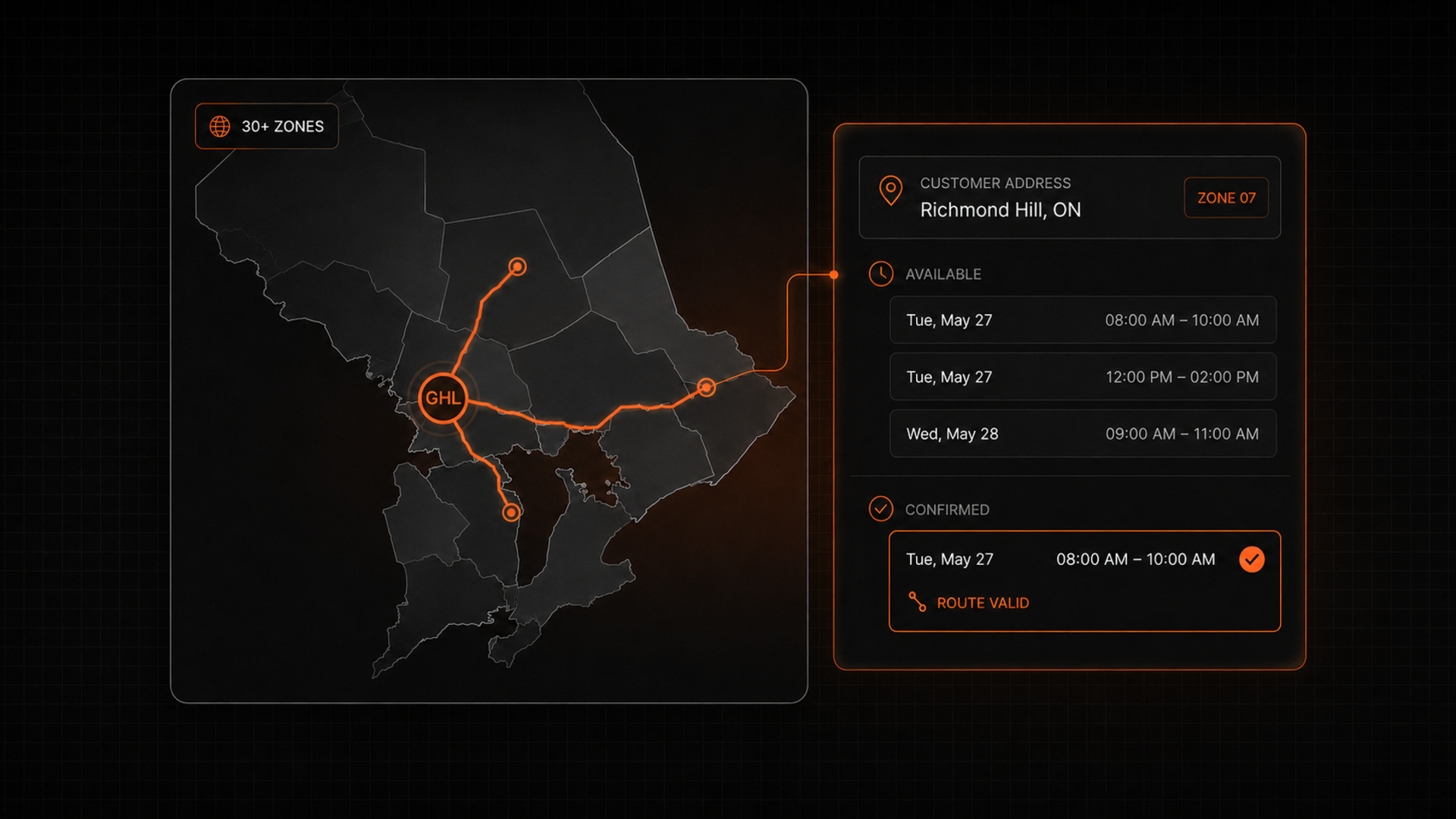
The hard part was never showing open time. It was knowing which open time was actually drivable. A naive overlap check treats two jobs forty minutes apart in opposite directions as a perfectly valid pair of bookings, then leaves the technician to absorb the cost on the road.
The data needed to make that call was scattered. Calendar events, blocked slots and service bookings all lived across different GoHighLevel endpoints in different shapes, and zone detection threatened a fresh geocoding call on every appointment read.
AM/PM blocks, fixed slots, travel buffers, HQ departure and per-agent weekly load — all evaluated before a slot is shown.
Hub IDs embedded in booking titles let every appointment read resolve its zone from the CRM record itself.
Nothing reaches the calendar until geography, buffer and load all clear.
Divided a wide, messy region into 30+ hub zones with HQ departure points, so geography became a value the system could reason about.
Three GoHighLevel endpoints, three shapes. One internal format now backs every availability decision.
AM/PM blocks, fixed slots, travel buffers and per-agent weekly load evaluated together, with hub IDs read from booking titles.
Fire-and-forget error logging so an API failure never blocks the customer, plus the internal scheduling portal.
Every slot a customer sees is a slot the fleet can actually drive — zone locks, travel buffers and per-technician load are checked before a time is offered.
The 30+ hub zones turn a wide service area into clean geographic blocks, removing the cross-region zigzag.
Bookings, reschedules and cancellations all live inside GoHighLevel — no duplicate entry, no second calendar.
The internal portal replaces phone-tag scheduling, and centralised logging surfaces API failures before a customer escalates.
From the start, they took real ownership of our development work not just executing tasks, but actually thinking through problems and coming back with ideas we hadn't considered.
We map exactly where your operation loses hours and which constraint to enforce first — specific to your fleet, not a case study.